Matching Algorithms
The core of simply is the different matching algorithms. They decide which bids and asks are matched together and at what price. Currently, simply has three matching algorithms: Pay-as-bid, Two-Sided Pay-as-clear and BEST matching.
They can be applied by using the
standalone simulation script match_market.py (see Running the simulation) or
via the static json-based wrapper functions (see simply.market_wrapper module).
Orders
There are two types of orders (see simply.actor.Order) that can be placed on the market:
bids (
Order.type=-1) are placed by actors looking to buy energy andasks (
Order.type=+1) are placed by actors looking to sell energy.
Besides the energy and price rate, an Order further holds the next time slot, the association to the cluster in the grid and the actor’s ID.
In case an Order has an energy of greater than maxint, i.e. 2**63-1, it is identified as
a Market Maker order to be understood as an infinite source and sink for electrical energy. Consequently, all actors
meeting the price criteria (potentially including grid fees) are guaranteed to be matched.
In contrast to a prosumer Actor the Market Maker does not have a schedule
and is not restricted by e.g. a battery capacity or a strategy.
Example Scenario
The following example scenario is used to illustrate the functioning of the matching mechanisms used across the simply matching algorithms. The scenario consists of a basic network of 5 actors across 2 clusters. Actors 0 and 4 are in Cluster 0 and Actors 1, 2, and 3 are in Cluster 1. There is a +1 grid-fee in-between the Cluster 0 and 1. Matches made between clusters, therefore, incur an additional cost of +1.
Network
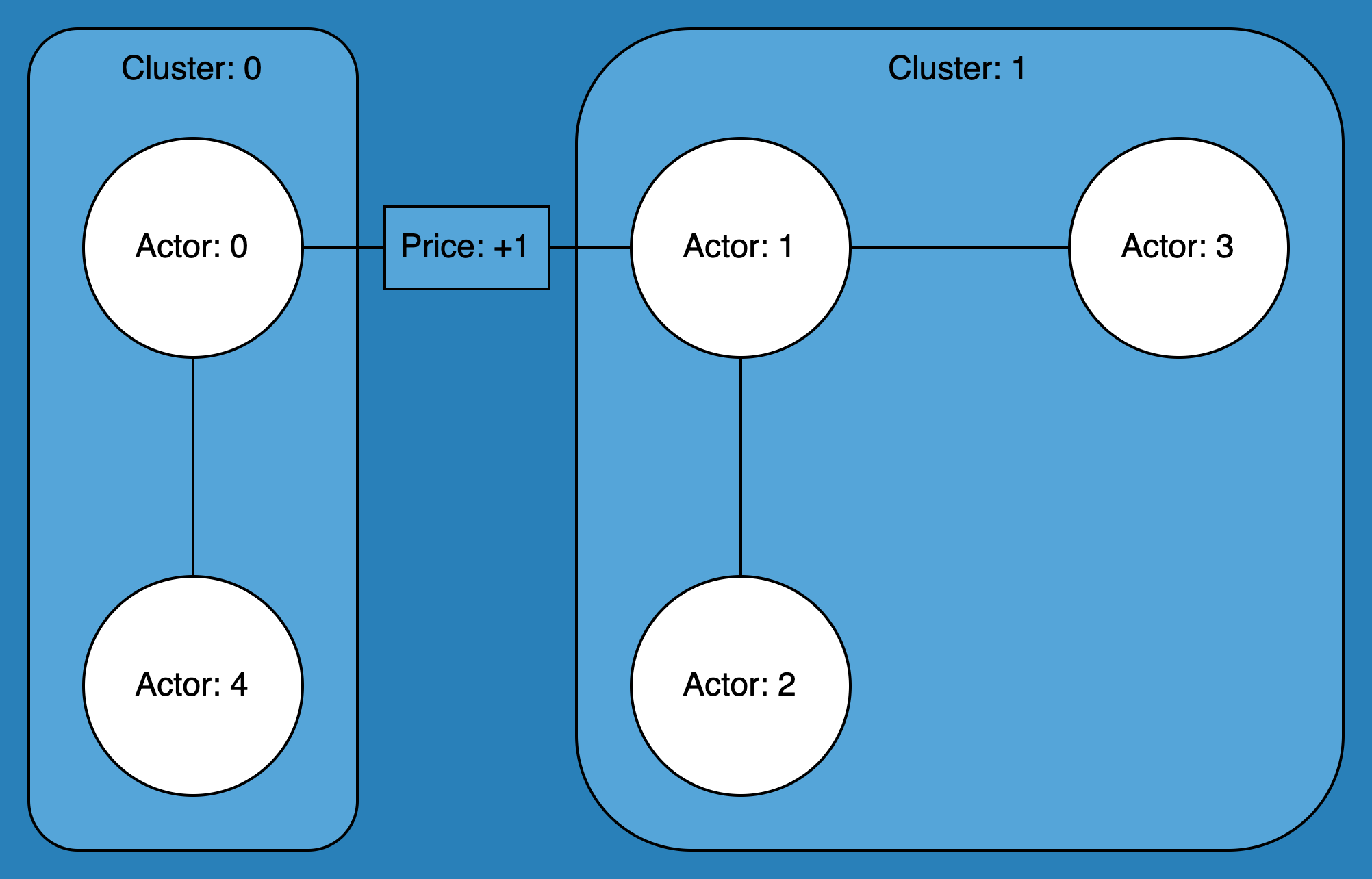
Figure 1: a basic network consisting of 5 actors across 2 clusters.
Grid-Fee Matrix
Grid-fees are calculated for each order using the following grid fee matrix:
Destination Cluster: 0 |
Destination Cluster: 1 |
|
|---|---|---|
Origin Cluster: 0 |
0 |
1 |
Origin Cluster: 1 |
1 |
0 |
Bids and Asks
For this example, using the network depicted above, 5 orders consisting of 3 bids and 2 asks are added into the market.
The Bids (buying energy)
Two bids, i.e. type=-1, each for 0.1 energy have been placed by Actor 1 in Cluster 1, of which one bid is set at the price of 10 and the other at the price of 7. The third bid is placed by Actor 0 in Cluster 0 and is for 0.1 energy at price 10.
The Asks (selling energy)
Both asks, i.e. type=1, added into the market are placed by Actor 3 in Cluster 1. Both are for 0.1 energy with one set at the price of 6 and the other at the price of 4.
The code below shows how a bids and asks can be set without the use of simulation script:
# from simply.actor import Order
Order = namedtuple("Order", ("type", "time", "actor_id", "cluster", "energy", "price"))

# Add bids
m.accept_order(Order(-1, 0, 1, 1, 0.1, 10))
m.accept_order(Order(-1, 0, 1, 1, 0.1, 7))
m.accept_order(Order(-1, 0, 0, 0, 0.1, 10))

# Add asks
m.accept_order(Order(1, 0, 3, 1, 0.1, 6))
m.accept_order(Order(1, 0, 3, 1, 0.1, 4))
Pay-as-Bid Algorithm
Using the Pay-as-Bid algorithm (found here: simply.market module), buyers are able to place bids in the market, alongside the asks placed by sellers. During each time slot, bids are sorted in descending order and asks are sorted in ascending order. Each offer is then compared with each bid, if the bid price is greater than the ask price, they are matched (partial matches of varying energy quantities are allowed).
The table below illustrates the matching of the Example Scenario:
Final Matches (Output):
Bids |
Asks |
Matched Price |
|---|---|---|
actor 0, order_id 2, price 10 |
actor 3, order_id 4, price 4 |
10 |
actor 1, order_id 0, price 10 |
actor 3, order_id 3, price 6 |
10 |
actor 1, order_id 1, price 7 |
Two-sided Pay-as-Clear Algorithm
Similarly to Pay-as-Bid, during each time slot, Two-sided Pay-as-Clear (found here: simply.market_2pac module) sorts bids in descending order and asks in ascending order. After the matching has taken place at this time slot, the highest matched ask price becomes the clearing price for all matched orders of this time slot. As one single clearing prices is identified, varying grid fees cannot be incorporated. Instead the default grid fee or a numeric grid fee matrix is used.
The table below illustrates the matching of the Example Scenario with grid fee matrix of 1:
Bids |
Asks |
Matched Price |
|---|---|---|
actor 1, order_id 0, price 10 |
actor 3, order_id 4, price 4 |
7 |
actor 0, order_id 2, price 10 |
actor 3, order_id 3, price 6 |
7 |
actor 1, order_id 1, price 7 |
BEST Matching Algorithm
The BEST matching algorithm (see simply.market_fair module) takes the network charge into account. In a first step, all clusters are matched individually. (A cluster contains all nodes between which a network charge of 0 is defined). For this purpose, the bids from the dedicated cluster and the asks from all clusters are considered. If an ask is matched in more than one cluster, the match is only kept in the cluster where the network charge is the lowest. The match is deleted from the other clusters. The clusters with deleted matches are then subjected to a new matching procedure. This procedure continues until no more duplicate matches occur.
The tables below illustrate the internal steps during the matching of the Example Scenario using BEST matching:
Matching Cluster 0 (Initial Attempt):
Bids |
Asks |
Matched Price |
|---|---|---|
actor 0, order_id 2, price 10 |
actor 3, order_id 4, price 5 |
5 |
actor 3, order_id 3, price 7 |
Matching Cluster 1 (Initial Attempt):
Bids |
Asks |
Matched Price |
|---|---|---|
actor 1, order_id 0, price 10 |
actor 3, order_id 4, price 4 |
6 |
actor 1, order_id 1, price 7 |
actor 3, order_id 3, price 6 |
6 |
Matching Cluster 0 (Rematch Attempt):
Bids |
Asks |
Matched Price |
|---|---|---|
actor 0, order_id 2, price 10 |
actor 3, order_id 3, price 7 |
7 |
Matching Cluster 0 (Rematch Attempt):
Bids |
Asks |
Matched Price |
|---|---|---|
actor 0, order_id 2, price 10 |
Final Matches (Output):
Bids |
Asks |
Matched Price |
|---|---|---|
actor 1, order_id 0, price 10 |
actor 3, order_id 4, price 4 |
6 |
actor 1, order_id 1, price 7 |
actor 3, order_id 3, price 6 |
6 |